Friction to Flow Suite · Value Stream Intelligence
Governance Tax Calculator
Quantify the hidden cost of approvals, handoffs, and decision delays. Map what adds value — and what taxes it.
New here?
Tax Rate—
VA Efficiency—
Risk Profile—
Annual Impact—
Load example:
Profile Progress0 of 4 sections
Governance Tax—
—
1
Process Profile
What are we measuring?Name the process you're analysing, its type and industry, and how often it runs. The annual volume scales each decision's cost into a full-year impact.
2
Value Stream Map (VSM)
VA vs. NVA timeSplit the time that creates real value (VA) from time lost to waiting, rework, hand-offs and approvals (NVA). Add handoffs and gates to map the process path.
Value-Add (VA): Steps that directly transform the outcome the stakeholder cares about. Non-Value-Add (NVA): Everything else — waiting, rework, hand-offs, approvals. Best-in-class organisations target 70%+ VA.
Waiting, rework, hand-offs, and approvals — everything that isn’t value-add
Process Time Breakdown—
Value-Add 0%
Non-Value-Add 0%
Each hand-off introduces context loss and wait time
Formal sign-offs, committee reviews, stage gates
3
Decision Latency Analysis
Core tax formulaCompare what a decision costs after approvals ($CC) versus made immediately ($BC), net of the risk that speed introduces. This drives the governance tax rate.
Financial Saving ($FS) = $CC − $BC
Risk Cost ($RC) = %R × $BC
Net Latency Score (DLS) = $FS − $RC
Governance Tax Rate = (DLS ÷ $BC) × 100
$
Average cost going through the current approval process
$
Average cost if the decision were made immediately
%
% of autonomous decisions that would be errors
Time elapsed between request and decision
$
4
Decision Point Factors
What to considerCheck the conditions that apply. Risk-amplifying factors suggest oversight is excessive; governance-justifying factors show it's warranted.
Check all factors that apply. Risk-amplifying factors suggest governance overhead is excessive. Governance-justifying factors indicate oversight has legitimate purpose.
Risk-Amplifying Factors — these increase governance tax
Governance-Justifying Factors — these reduce effective tax rate
Governance Tax Rate
—
governance tax
Enter values to calculate
Financial Impact
Financial Saving ($FS)
—
Risk Cost ($RC)
—
Net Latency Score
—
Approval Overhead
—
Annual Tax Burden
—
Annual Risk Exposure
—
Value Stream Efficiency
VA —NVA —PCE —
Industry Benchmarks (VA%)
Typical organisations: 5–25% VA time
Lean-improving: 25–50% VA time
Best-in-class: 70–95% VA time
Risk Profile
—
—
Select your process details to generate a risk profile.
Recommendations
Complete input sections to receive personalised recommendations.
Optimization Levers
Increase
Flow
Autonomy
Accountability
Feedback loops
Goal alignment
Impact measures
Reduce
Handoffs
Bureaucracy
Context switching
Complexity
Risk avoidance
Utilization pressure
Your prioritised lever recommendations will appear here after entering values.
The Friction to Flow Suite
One playbook. A full suite to put it to work.
Playbook resources, assessments, education, and advisory — one connected suite that helps you see friction, quantify its cost, and design the flow that replaces it. Accelerate value. Eliminate drag. Retain control.
The Suite
Products in the F2F family
Four connected layers — playbook resources, assessments, education, and advisory. The Governance Tax Calculator and the White Paper + Guide are available today; the rest of the portfolio is in active development.
01 · Playbook Resources
Live
Governance Tax Calculator
Estimate the cost of approvals, delays, and handoffs in any process — like a mortgage calculator for bureaucracy. Quantify decision latency in time and money, with a value-stream view and risk profile.
New
White Paper + Guide
The complete Friction to Flow playbook as a downloadable white paper and guide — the case for flow, the governance tax model, five systemic plays, the tactical loop, and twelve levers of change.
In Development
Friction Mapping Canvas
A structured one-page canvas that helps teams visualize where work slows within a process area — surfacing where approvals, handoffs, and unclear ownership create drag.
In Development
Levers of Change Decision Guide
A practical decision-matrix guide to choosing the right intervention — which lever to pull, from decision rights to process simplification, for targeted changes that stick.
New
AI Prompt Library
Ready-to-use, structured prompts that let your teams apply the playbook with the AI tools they already have — find friction, quantify hidden costs, explore solutions.
02 · Assessments & Certification
In Development
Governance Effectiveness Assessment & Heatmap
How effectively does your governance support — or hinder — the flow of work? Scored across key process areas and human capabilities, delivered as a visual heatmap with an expert-delivered report recommending which plays to prioritize.
In Development
Governance Tax Assessment
A rigorous, per-process-area measurement of the hidden cost of bureaucracy — delays, rework, and excessive approvals quantified in time and effort. Run several areas to prioritize where change pays off most.
Planned
F2F Organizational Certification
Recognition that your organization has built the capability to reduce unnecessary friction and make work flow — a mark of progress for employees, customers, and stakeholders.
03 · Education
In Development
Hurry Up and Wait!
A fast, engaging one-hour primer: most delays aren’t caused by people, but by how work is designed. Learn to spot where work gets stuck — and how small changes make a big difference.
In Development
Rules without Roadblocks
Are you spending $5 to save $1? A half-day course on governance for smarter risk and stronger outcomes — build systems that enable speed, smart risk-taking, and real accountability. (3.5 hrs)
In Development
Unlock AI’s Full Potential
Break through the barriers to business impact. Uncover the workforce, process, and system constraints blocking your AI ROI — and learn how to remove them. (2.5 hrs)
Planned
Workshops & Leadership Studio
Multi-day immersive formats: the Friction to Flow Mapping Workshop, the Human & Machine Workflow Workout, and the Leadership Studio: Designing for Flow. Coherent multi-day events can be assembled to fit your needs.
04 · Advisory
Available
Friction Investigation Cycles
Focused advisory engagements — typically 2–3 cycles — that trace, quantify, and reduce friction in a specific business area, working alongside your teams and leaving the capability with you.
In Development
F2F LLM / GPT Build Instructions
Step-by-step instructions to create an AI assistant trained on the playbook — embedding F2F guidance into day-to-day work, on demand, at scale.
Available
Mentorship Packages
Prepaid hours of direct expert guidance for leaders and teams — flexible support for reducing delays and redesigning governance, without a full consulting engagement.
Baseline · Focus · Certify
One connected journey
Start free: estimate your governance tax and read the playbook. Assess to baseline how governance supports — or hinders — flow, and get a human-delivered report on which plays to prioritize. Build the capability through education, apply it with advisory, and certify the result. Insight in one layer compounds across the rest.
Built On
The methodology behind the suite
Value Stream Mapping
Separate value-add from non-value-add time to see where flow breaks down and where to focus improvement.
Decision Latency
Quantify the cost of waiting — the gap between current cost and best cost, net of the risk that speed introduces.
Right-Sized Governance
Match oversight to actual risk. Keep what protects value; remove what only taxes it. Move toward audit-based control.
F2F AI Prompt Library
Run the playbook with the AI you already have.
Copy-ready prompts for every Friction to Flow activity — trace the friction, quantify the tax, filter the controls, pick the lever, redesign the gate, and make the case. They work in Claude, ChatGPT, Gemini, or Copilot.
These prompts work in any AI tool. Copy one, paste it into your tool, and replace the [[ bracketed slots ]] with your own context. They follow the playbook journey — the same order as the tactical loop.
One rule, and it matters: walk the flow by hand first, with the people who live in it. AI accelerates and pressure-tests your thinking — it has not seen your queue, your politics, or your customer. Use these prompts after your own first attempt, and treat every number it produces as a draft until you have checked it.
1 · Tactical loop — Trace
Friction Finder
When to use it: when you know which process hurts but not exactly where or why. Coach mode walks the flow with you stage by stage — including the human and political friction the documented process hides.
Act as an operational-flow coach using the X2A "Friction to Flow" method. I am going to trace the friction in one of my organization's processes: following the work end to end and mapping every approval, handoff, queue, and checkpoint. Your job is to coach me, not to do it for me.

Key definitions:
- Friction is anything that impedes the smooth flow of work, decisions, or value.
- Good friction is proportionate to a real risk. Bad friction manages anxiety, not risk.
- A handoff is any transfer of work between people, teams, or silos (the horizontal cost).
- An approval gate is any point where work must travel up for sign-off (the vertical cost).

We will work in steps. Do not skip ahead.

1. First, ask me for the process I am tracing, who its customer is (internal or external), and what outcome the process exists to serve.
2. Walk me through the flow one stage at a time. At each stage ask: what happens, who owns it, how long the work takes versus how long it waits, what approvals or checks gate it, and what gets handed off to whom. Keep me concrete; one pointed question at a time.
3. After the official flow, ask about the human friction the documented process hides: unclear boundaries (who owns what, what must be escalated, what never should be), political workarounds, and the relationships the work really moves through.
4. Then reflect the full map back to me: every approval gate, handoff, queue, and checkpoint in order, with work time versus wait time, and flag the three points where the friction looks most disproportionate to the risk it manages.
5. Ask me which one hurts most before you suggest anything.

Here is my starting context: [[ the process area, who its customer is, and why you picked it ]]
Every button copies the prompt first. Claude and ChatGPT open with it filled in; Gemini and Copilot open ready for you to paste.
Faster one-shot version (generate mode)
Act as an operations analyst using the X2A "Friction to Flow" method. Build a friction map of the process I describe.

Produce a table with columns: Stage | What happens | Owner | Work time | Wait time | Gates & checks | Handoffs | Friction signals.

Then list: (a) the three frictions that look most disproportionate to the risk they manage, and why; (b) any human or political friction my description hints at but does not name; (c) what I should quantify next to make the strongest case.

Rules: distinguish work time from wait time everywhere. Treat every approval as a queue until proven otherwise. Do not propose fixes yet — this step is diagnosis only.

Here is the process as I understand it today: [[ describe the flow stage by stage, including who approves what and where work waits ]]
Every button copies the prompt first. Claude and ChatGPT open with it filled in; Gemini and Copilot open ready for you to paste.
Check the output before you trust it:· Did it separate work time from wait time at every stage, or blur them? · Did the human-friction pass surface anything the official flow hides? If not, push it. · Are the flagged top-three tied to disproportionate risk, or just to annoyance?
2 · Tactical loop — Quantify
Governance Tax Estimator
When to use it: after you have traced the flow. Turns the friction into a defensible number using the same decision-latency model as the Governance Tax Calculator in this app — use the prompt when you want the reasoning in your own AI tool.
You are an analyst using the X2A "Friction to Flow" method. Help me estimate the governance tax of one process: the measurable cost of its bureaucracy across four factors — decision latency, handoffs, approval gates, and compliance activities.

Use this model for decision latency:
- Current cost (CC): the average cost of the outcome under today's process, including the delay.
- Best cost (BC): the average cost if the decision were made immediately.
- Risk rate (R): the honest share of decisions that would be mistakes without the control (assume a mistaken decision loses the full BC).
- Net saving per decision = (CC - BC) - (R x BC).
- Governance tax rate = net saving / BC x 100. A negative tax rate means the control pays for itself: keep it.

Work through it with me, one factor at a time:
1. Decision latency: ask me for CC, BC, and R for the key gated decision, then compute the net saving and the tax rate, showing your arithmetic.
2. Handoffs: ask how many handoffs the flow contains and roughly how much of the elapsed time is value-adding versus waiting; estimate the queue and rework cost.
3. Approval gates: ask for each gate's typical queue time and its ratification rate (how often it actually changes the outcome). Flag any gate that ratifies more than 95% of what reaches it as a candidate for audit-based governance.
4. Compliance activities: ask what non-value-adding-but-necessary work the process carries, and whether a lower-friction method could achieve the same assurance.
5. Summarize: the annualized cost at my volume, the overall tax rate, which factor dominates, and the single most defensible number I can take to leadership.

Be conservative: when I give a range, use the low end. Label every assumption you make.

My process and first numbers: [[ the process; how many times it runs per year; average current cost; best cost if decided immediately; your honest error rate without the control ]]
Every button copies the prompt first. Claude and ChatGPT open with it filled in; Gemini and Copilot open ready for you to paste.
Check the output before you trust it:· Is the risk rate honest — not zero? A control with real risk behind it can earn a negative tax, and that means keep it. · Did it stay conservative and label every assumption? · Is the final number one you would defend in front of the CFO?
3 · Systemic play — Filter
Good Friction from Bad
When to use it: when you are ready to sort a governance area's controls into keep, tune, or remove — the first systemic play. Run it after quantifying, so proportionality is a number, not an opinion.
You are a governance analyst using the X2A "Friction to Flow" method. Help me filter the good friction from the bad in one governance area, sorting every control into KEEP, TUNE, or REMOVE.

Apply three tests to every control:
- Proportionality: is the weight of the control proportionate to the quantified risk it manages? Most organizations spend $5 of control to save $1 of risk.
- Reversibility: does it gate a two-way-door decision (reversible: deserves flow) or a one-way-door decision (irreversible: deserves friction)?
- Risk versus anxiety: controls exist to manage risk, not anxiety. If nobody can name the risk, it is a zombie control.

Process:
1. Ask me to inventory the controls in the area: approvals, sign-offs, checkpoints, mandatory reviews, policies.
2. For each control, ask: what risk does it actually mitigate, what would happen if it failed, is the gated decision reversible, when and why was it added, and who would notice if it disappeared tomorrow.
3. Sort every control into: KEEP (proportionate and protective), TUNE (right intent, wrong weight — say exactly what to lighten), or REMOVE (manages anxiety, not risk).
4. For every REMOVE, name the lightweight safeguard that keeps the safety without the queue: a guardrail, a micro-audit, or an after-action review.
5. Finish with the public declaration a leader should make: the friction we are keeping on purpose, the friction we are removing, and the trade-offs we accept.

Rules: never recommend removing a control that manages an irreversible, high-impact, or legally required risk — mark it KEEP even if it is annoying. Where a startup-style unit lacks needed friction, say so: the goal is right-sized friction, not zero friction.

My governance area and its controls as I know them: [[ the area, and every approval, checkpoint, and rule you can list ]]
Every button copies the prompt first. Claude and ChatGPT open with it filled in; Gemini and Copilot open ready for you to paste.
Check the output before you trust it:· Did every REMOVE get a replacement safeguard? Removal without a safeguard is a trust-breaker. · Did it respect the one-way doors — legal, safety, irreversible calls stay KEEP? · Could you read the closing declaration aloud to your team as-is?
4 · Tactical loop — Refine
Lever Selector
When to use it: after tracing and quantifying, when it is time to change one thing. Picks the smallest change with the biggest impact from the twelve F2F levers and writes your one-page cycle charter.
You are a change designer using the X2A "Friction to Flow" method. I have traced and quantified friction in a process. Help me choose the smallest change with the biggest impact, using the F2F levers of change:

1 Declare the friction worth keeping · 2 Move a decision down · 3 Remove one approval layer · 4 Collapse a handoff · 5 Replace a rule with a guardrail · 6 Sunset a zombie control · 7 Shift a gate from approval to audit · 8 Name the flow owner · 9 Make flow visible at the executive table · 10 Rebalance a tension (e.g. safety vs speed) · 11 Redesign the escalation path · 12 Align the measures.

Steps:
1. Ask me for my traced frictions and their governance tax numbers if I have them.
2. Recommend the two or three levers that best fit, and say why each fits — matched to the friction type (vertical gates, horizontal handoffs, zombie controls, conflicting incentives).
3. Pick the single smallest-biggest change and design the nudge in detail: exactly what changes, who announces it, what people do differently on day one, and what stays the same (do not design a transformation program).
4. Define the measurement: the baseline number, the number expected to move, and the review date.
5. Output a one-page cycle charter: process area; customer of the process; top three frictions and their tax rates; the one lever being pulled; the owner; the review date.

Rules: one lever per cycle. If I push for several at once, push back. Every control removed must keep its accountability through a lighter mechanism.

My traced friction and numbers: [[ paste your friction map and tax figures, or describe them ]]
Every button copies the prompt first. Claude and ChatGPT open with it filled in; Gemini and Copilot open ready for you to paste.
Check the output before you trust it:· One lever, one cycle — did it try to bundle three changes into a program? · Is the nudge concrete enough that people know what to do differently on day one? · Does the charter name a baseline number, a target number, and a review date?
5 · Redesign — Approval to Audit
Gate Redesigner
When to use it: when one approval gate keeps ratifying everything that reaches it. Redesigns it as audit-based governance: a guardrail people act inside, micro-audits that catch the exceptions, and ratification after the fact.
You are a governance designer using the X2A "Friction to Flow" method. Help me redesign one approval gate into audit-based governance: act, then verify.

Context to apply:
- Approval-based governance is "stop until I tell you to continue" — a 150-year-old default built on the assumption that workers lack judgment. In organizations that shift standing approval bodies to after-the-fact ratification, 95-98% of decisions are ratified unchanged.
- The five-word policy test: Netflix's entire travel policy is "Act in Netflix's best interest" — intent plus boundary, backed by after-the-fact verification. Ask of my policy: could five words plus a micro-audit replace five pages plus an approval chain?

Steps:
1. Ask me about the gate: what it approves, who queues behind it, the typical wait, its ratification rate, and whether the gated decisions are reversible.
2. Draft the guardrail: a policy of intent and boundaries in as few words as possible. People act freely inside it.
3. Design the micro-audit: two to four anomaly signals, the detection cadence (weekly or near-real-time), who reviews flags and within what turnaround, and how false positives get tuned out. A flag triggers a conversation, not a tribunal.
4. Define retrospective ratification: how decisions are reported to the control body after the fact, and what genuinely justifies a rollback (e.g. confidential context the decision-maker could not have known).
5. Name what still requires pre-approval: one-way-door decisions, and legally or safety-mandated checks. Be explicit — this is what makes the rest safe to free.
6. Output a one-page before/after: old flow versus new flow, the queue time removed, and the trust story for auditors and boards — automated audit trails scale trust, they do not weaken it.

My gate: [[ the approval gate; what it gates; who approves; typical wait; how often it actually changes the outcome ]]
Every button copies the prompt first. Claude and ChatGPT open with it filled in; Gemini and Copilot open ready for you to paste.
Check the output before you trust it:· Is the guardrail genuinely short — intent and boundary, not a policy in disguise? · Do the micro-audit signals have an owner and a turnaround, or are they vague monitoring? · Is the list of what still needs pre-approval explicit? That list is what makes the rest safe.
6 · Capstone — Make the Case
The Case for Flow
When to use it: when your cycle is done and you need leadership on board. A synthesis prompt: it compiles your trace, tax numbers, filter decisions, and chosen lever into a tight executive case — it does not invent your strategy for you.
You are a senior advisor using the X2A "Friction to Flow" method. Compile my friction work into a concise executive case for change. This is a synthesis prompt: polish and connect what I give you — do not invent facts about my organization. Where an input is missing, make a clearly labeled [DRAFT] attempt and flag what I need to validate.

Structure (keep each section tight and scannable):
1. The friction, in one paragraph: the process, its customer, and where work waits.
2. The governance tax: the numbers — decision latency, handoffs, approval gates, compliance load — with the annualized cost and tax rate up front. A defensible number travels up an organization in a way frustration never does.
3. What we keep on purpose: the good friction, and the risks it genuinely manages.
4. The proposed change: the one lever being pulled, the guardrail or micro-audit that preserves accountability, and why this is a nudge, not a program.
5. Risk and rollback: what could go wrong, how quickly we would detect it (early detection design), and how we roll back — most of these decisions are two-way doors.
6. How we will know: the baseline number, the number that should move, and the review date.
7. The ask: the specific decision I need from leadership, at the lowest responsible level.

Rules: be conservative with every number and label every assumption. No transformation language — this is one governance area, one lever, one review date. End with the one-sentence version of the whole case.

Here is my work so far:
- Friction map: [[ paste from your trace step ]]
- Tax numbers: [[ paste from your quantify step, or the calculator ]]
- Keep/tune/remove decisions: [[ paste from your filter step, or write "draft this" ]]
- Chosen lever and measurement: [[ paste from your refine step, or write "draft this" ]]
Every button copies the prompt first. Claude and ChatGPT open with it filled in; Gemini and Copilot open ready for you to paste.
Check the output before you trust it:· Did you apply real judgment to everything it marked [DRAFT] before sharing? · Does the case lead with the number, not the frustration? · Is the ask one decision, at the lowest responsible level — not a steering committee?
Friction to Flow
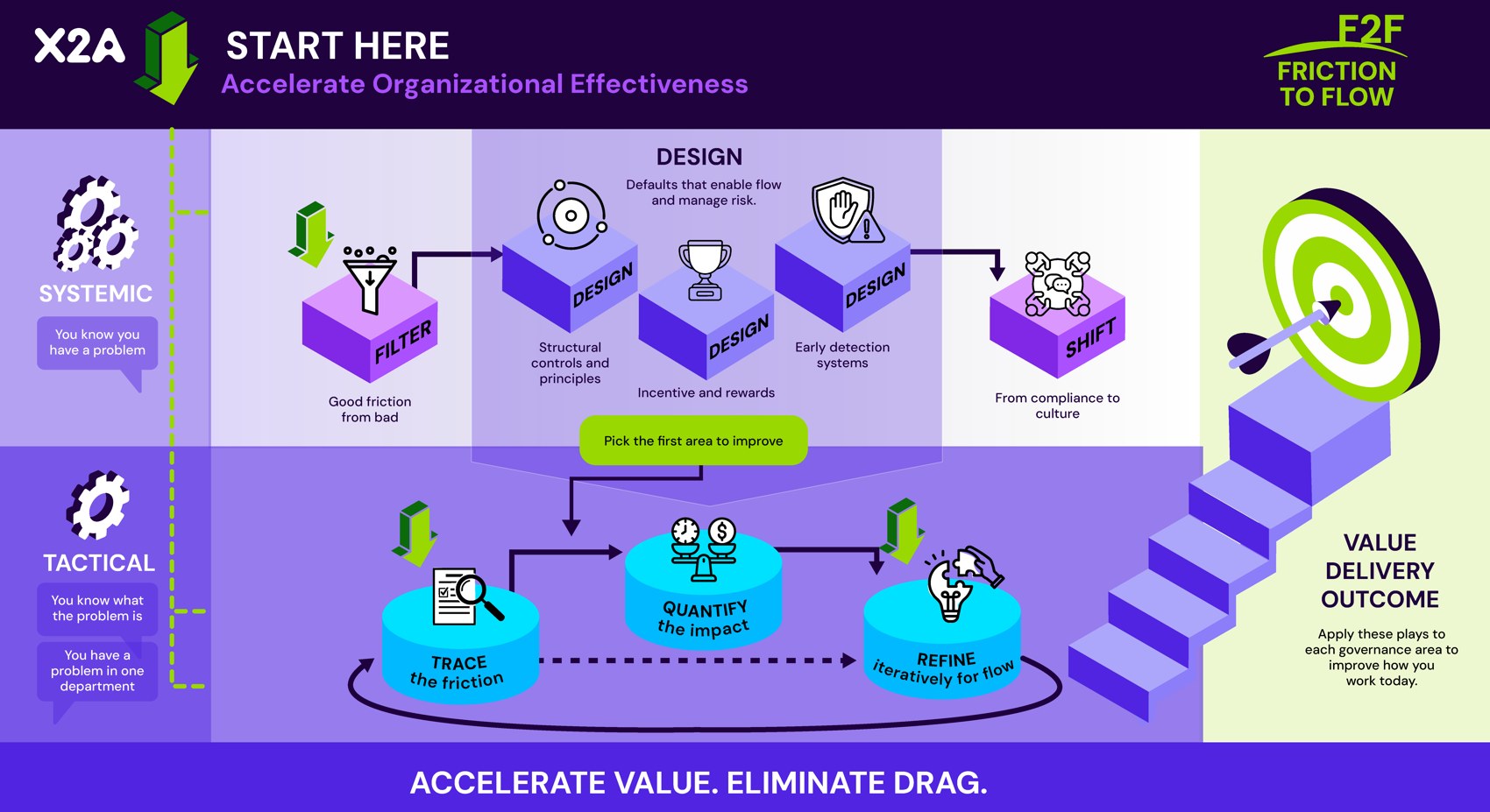
The F2F journey, at a glance
From systemic and tactical starting points through design, delivery, and value outcome — the full Friction to Flow operating picture. Click the image to view full screen.
Friction to Flow — Accelerate Value. Eliminate Drag. · X2A F2F Suite
Systemic Entry
Begins with quad-motion analysis, structural controls and prompts, and early-detection systems — the system-level levers that shape how value moves.
Tactical Entry
The Trace → Blueprint → Refine loop — a hands-on path that takes a specific friction point from problem to redesigned flow.
Design Stage
Translates inputs into detected issues, applied design responses, and the cultural shifts needed to make new ways of working stick.
Value Delivery Outcome
The target: apply changes to realize measurable value and improve how work flows — accelerating value while eliminating drag.